We were 16
sitting on the curb after late shift,
scraping grease and French fries
off our regulation white shoes
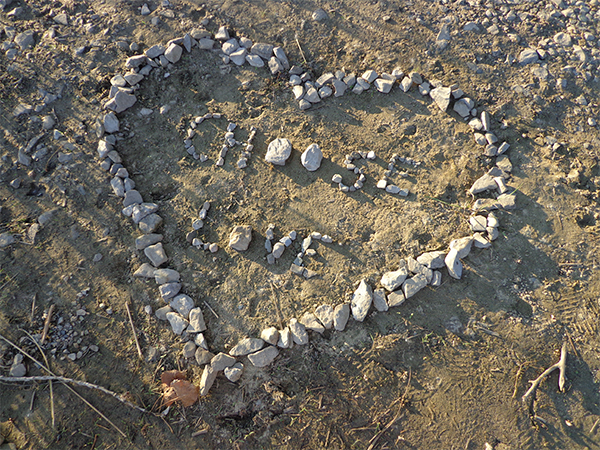
with a stone.
We smoked cigars
in the McDonald’s parking lot
where $3.85 an hour
is power.
We were 16
sitting on the curb after late shift,
scraping grease and French fries
off our regulation white shoes
with a stone.
We smoked cigars
in the McDonald’s parking lot
where $3.85 an hour
is power.
Recently, I used energy healing to help a woman who was sexually abused by her father ages 2 – 9.
Mary Magdalen stood across from me, and we worked on “Annie” together. I saw her lying under deep water. I unplugged the bottom like a tub and it drained tears and sadness. When the water was gone, I saw a little girl – pale, tiny, naked except for dirty panties. Mary Magdalen told me to cover her. “Not a dress,” I said. Annie did not want to be pretty or accessible. Mary Magdalen said, “Any clothes you want.”
So, I put a thick shirt on her and buttoned it up to her chin. Next- a big bulky sweater, a hood, and then new underwear with yellow ducks, thick jeans, big red wool socks and red kids’ sneakers. (Red for grounding.)
After the procedure, I told her it was not just to cover her, but I felt the clothes protected her somehow.
Annie said she used clothes as protection from her father. She used to wear four pairs of pajamas to bed.
I almost lost it then, thinking of that tiny body and child logic and 8 years.
I did more healing work on her that session. (I generally remove old emotions and stuck energy from organs and chakras.) Her email the following week said that she felt better than she had ever felt in her life. She was euphoric. In the following weeks, she started a new job and a new romantic relationship, feeling safe with a man “for the first time ever.”
A month later, “Danielle” showed up at my door with a wrist that still hurt 9 months after breaking it, with aches that travelled up her arm. The doctor had dismissed her pain as imaginary, insisting the wrist was properly healed.
Muscle testing led me to this equation: Root chakra + father + sore arm / wrist = resisting sexual attack (putting out her hand to stop him and failing to do so).
I balanced the root chakra by removing a metal rod (penis) and a steel box (of secrets).
When I shared this information, Danielle told me that her father had abused her.
Mother Mary came in with blue and white light. She flooded us with intense love. I feel her love as a gentle hand on my left cheek, my heart bursting and goosebumps from head to toes. Mother Mary held Danielle and rocked her as she sobbed. This was a secret she had carried many many years, and just speaking it was a great release.
Next, Mother Mary and I worked on Danielle together. I saw Danielle covered in deep water – overwhelmed. I pulled the plug, and it drained slowly. Then I saw a naked little girl, about 8 years old. She thought she was ugly and worthless. I played with her long blond hair. “Such pretty hair,” I told her. I put a pink bow on one side.
“Such a pretty girl,” I said. I touched her face with love. Mother Mary was doing similar things- washing her, erasing the hurts. This deprived little girl wanted pretty clothes: a lavender dress with pockets and a necklace with a heart charm. I gave her frilly white socks and shiny red shoes.
The above 2 procedures on Danielle took about 15 minutes, but I worked on her for 50 minutes in total. Danielle said that memories had flooded her during this session- things she had forgotten- a rape in the woods, molestation by a teacher. This beautiful woman said that she had felt ugly all her life and had often wondered why men pursued her at all.
Her wrist and arm stopped aching within a day.
_____________________________________________
Shorter version first published in Tone Magazine, Jan. 2017. Email me at thewordnotspoken@gmail.com for a healing session- long distance or in-person (Ottawa) $90.00
As of 2020, I am no longer working with visiting entities. I think that a human such as myself is limited when it comes to detecting corruption in some of these beings. Unless it’s your Grandpa, of course. I’m fine with passing on messages with those visitors. I mean beings who want to help with healings. I didn’t have any bad experiences, I just think there’s a risk.
The king’s anger quakes the earth,
buries men alive, splits women open.
Soil-scented pleasures
inflicted by him, mud-wet
treasures and swords
belong to him.
He planned it all out as a boy
on a pile of dirt
in his friend’s driveway.

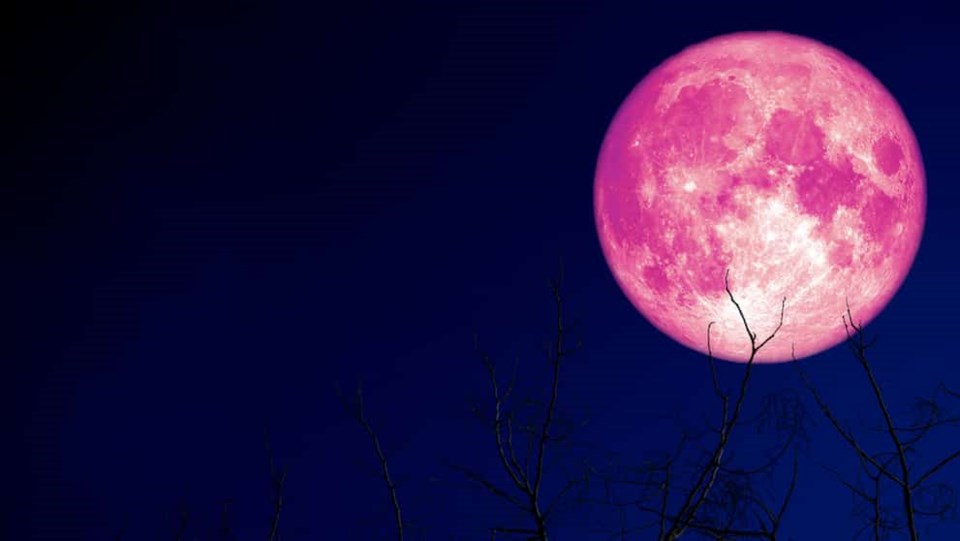
According to the Ojibwe, the sixth moon of Creation is Strawberry Moon. “The medicine of the strawberry is reconciliation. It was during this moon cycle that communities usually held their annual feasts, welcoming everyone home, regardless of their differences over the past year, letting go of judgment and/or self righteousness.” (more moons)
Generally, for the rest of us, this has come to mean the full moon in June that is closest to Solstice. This year, the full moon is on the same day as summer solstice. A magical moon indeed… and I was excited to get up in time to see it at dawn.
The sky was lightening at 5 am as I hurried to the river’s edge, worried I’d miss the special moment: sunrise on summer solstice. I was warm in shorts and t-shirt as I came to the Ottawa River and stopped short.
There it was! A strawberry moon! Perhaps a little more peach than pink, but oh…. huge, close to the horizon, bright in the morning sky and reflecting on the grey water.
We haven’t had a full moon on the same day as summer solstice since 1967. Today sunrise was at 5:14 am and sunset will be 8:50 pm. It’s a long day for those who are observing Ramadan- 15 1/2 hours without food, water or cigarettes. “Strawberry” refers to June- time to start picking- but also to the colour of the moon, caused by the great distance between the earth and the moon today.
I enjoy exploring the extreme edges of this day. Usually I stay awake all night, awed by how short it is. Tonight as the sun sets, that great pink moon will flood us with light. If it is cloudless, the sky may not darken at all.
I revel in the light, loll about in the warmth, leave sunglasses in the car. My sunrise appreciation was simple- throwing out thanks to the sky listing the many blessings in my life. Then just doing Qigong in the peace – you might think it was quiet, but oh, the quacking ducks, the chorus of birds and my exploding heart…. it was a noisy celebration.
Happy solstice! Light be upon you.
Oh happy day: the day we first feel spring in the air. The first day that shoes replace boots- the light feet, the utter joy. That’s the Canadian’s late March experience, but in Mediterranean countries, they are seeing spring blooms by now, discarding jackets, eating the first local greens.
Newroz celebrates the arrival of spring and is usually celebrated around March 20, coinciding with the Northward Equinox. It has been celebrated for centuries in Iranian, Armenian, Azerbaijanian and Kurdish cultures; it was first mentioned in Kurdish poetry in the 16th century.
In Northern Kurdistan (East Turkey), Newroz is almost always celebrated with a picnic. When I visited family there, we lugged a hibatchi-type BBQ out to the woods by a stream, played hide and seek games among the trees, sang songs and feasted on tomato salad, flat bread and chicken (killed in the backyard that morning). Sometimes whole communities celebrate together with dancing and music.
In The Word Not Spoken, Ahmet uses Newroz to divert Leigh’s fears when he tells her on their wedding night that he is a freedom fighter, part of the PKK:
Ahmet hesitated. “We tell tourists and journalists about the human rights abuse and the democracy problem here.”
Leigh was relieved. “You just talk to people?”
“Yes. We are non-violent group.”
“What do you do?”
“I go to meeting every month. Right now we are planning Newroz celebrations and demonstrations.”
Ahmet explained that Newroz was celebrated on the first day of spring in Kurdistan, comparable to a New Year’s celebration in the west. It had never been celebrated by Turks, and so, over the past decades, Newroz had become an opportunity to assert Kurdish culture and identity. Only three years previous, a crowd dancing in a village square in Mersin had been fired upon by watching Turkish tanks.
“Ahmet, you don’t go to the Newroz celebration do you?”
“No. I plan it just, but I cannot be there.”
Leigh gets more information later in the story. By this time, she has met Kurdish refugees dying in tents, and she has started to write their story. Here Ahmet is telling her about his cell’s meeting the night before and what they discussed:
“We are planning Newroz. It is very important, a very strong day for my people.”
March 21st was only a couple of weeks away. Ahmet explained that this would be, as always, a celebration of spring and the new year for the people of East Turkey and parts of Syria, Iraq and Iran. The anti-government groups sought to protect the Kurdish people so that they could dress in traditional costume and dance in village squares without the army harassing them.
“Write this,” dictated Ahmet. “Ahmet says, ‘Freedom is not cheap. It is better for a Kurd to die dancing than in a burning house.’”
“Like that. With his finger in the air,” said Leigh, writing.
Newroz would happen no matter what, Ahmet pointed out. The people would be out. The only variable was what the army’s reaction would be. Some cities planned massive peaceful demonstrations. Others planned simple celebrations. Ahmet said the important thing was the Kurdish people would be seen asserting their identity and culture. The truth was Newroz had become a propaganda vehicle. It was an assertion of Kurdish identity, encouraged by pro-Kurdish groups. Ahmet said the largest demonstrations were organized in cities with weak Kurdish undergrounds. This would occupy M.I.T.’s (the secret police) attention. As well, none of the important leaders would attend. The goal was complete safety for the demonstrators.
“What else did you talk about?” asked Leigh.
This was my reality when I lived in Turkey in the mid-90s. Newroz was a time of fear and supreme courage. I preferred delightful family picnics to public gatherings; I hated the feeling of ducking my head, checking my back, walking in front of soldiers with guns in hand.
I cannot adequately share my shock when during later visits to Turkey I learned that the Turkish government had done an about-face and declared Newroz to be a Turkish holiday! If you can’t beat ‘em, join ‘em, I guess.
“The Turkish government suddenly announced that the Kurdish new year’s holiday Newroz, was in fact a Turkish holiday commemorating the day the Turks first left their ancestral Asian homeland, Ergenekon. The day was renamed Nevruz since the letter ‘w’ was not in the Turkish alphabet.” (Nationalisms and Politics in Turkey by Casier & Jongerden)
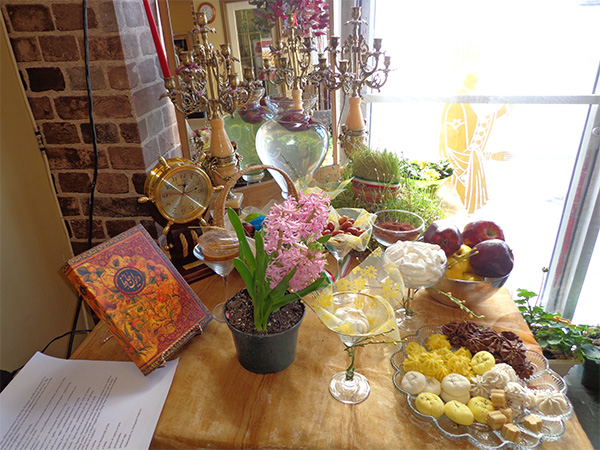
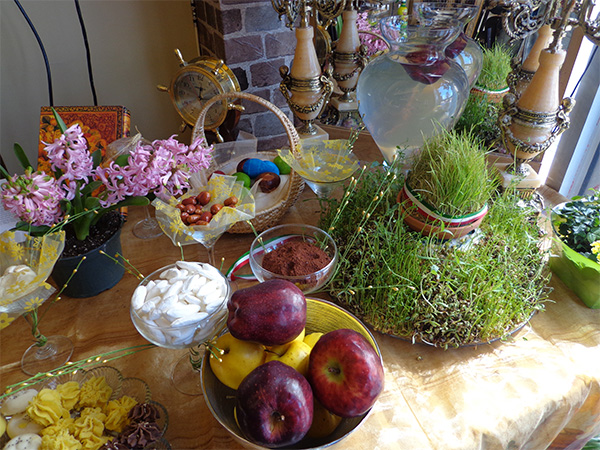
In Iran, a table called Haft-seen is displayed at Newroz. Haft-seen means 7S because seven items beginning with the letter ‘s’ must be on the table along with other more personal items. The seven items are: “Sumac (crushed spice of berries) to symbolize the sunrise and the spice of life, Senjed (sweet dry fruit of the lotus tree) for love and affection,Serkeh (vinegar) for patience and age, Seeb (apples) for health and beauty, Sir(garlic) for good health, Samanu (wheat pudding) for fertility and the sweetness of life, and Sabzeh (sprouted wheat grass) for rebirth and renewal of nature.” Huffpost Religion
Personal additions to the Haft-seen table may include poetry, books, a mirror (reflection on the past year), a bowl of real goldfish (new life), colored eggs (fertility), coins (prosperity), flowers (spring), and candles (light and happiness).
I photographed this Haft-seen table at Saffron Restaurant, 462 Rideau St., Ottawa. The owner was so pleased with my interest that she explained every item on the table to me.
Happy Spring! Happy Newroz!
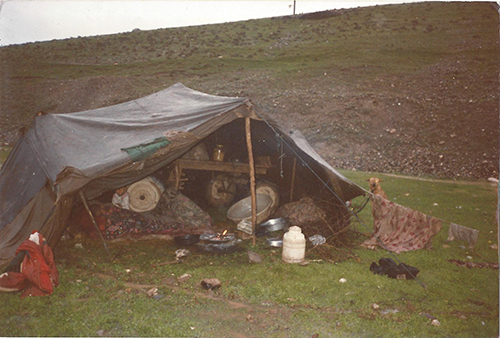
I was teaching “housing” to a literacy class one morning, and I passed around a pile of photos. The photos were of places I have lived: a tiny Japanese apartment with tatami mat floors, a windowless room in Kathmandu, a cave in Turkey, the Canadian bungalow I grew up in. I had photos of residences I have visited: a villa in Istanbul, Windsor Palace, an orphanage in Bhaktapur, a yacht in the Mediterranean, a hut in Kerala… a floor-less tent in Kurdistan.
A shout rose, “Laurie, my house! My house same!”
Other students joined in- “Yes, same my house! Refugee camp!”
A number of the students were refugees from Bhutan who fled to Nepal 2 decades ago. I was shocked at the recognition- this tent, this shocking poverty- was getting grins of recognition.
I suppose refugees’ homes are similar whether they are great groups of tents (more than 35,000 lived in the Nepali refugee camps at their peak) or 54 people in 3 tents on a great plain (the Kurdish refugees that I met in 1996). Some camps are big enough to attract aid; some are isolated and without aid. But home is home and even in refugee camps I hear of pets, sickness, births, friends, jobs, domestic abuse, alcoholism and weddings.

Lately I’ve been hearing a good many refugee stories- at fundraisers for Syrians, on the radio and in the newspapers. I heard a Vietnamese refugee speak of her experience as a “Boat Person” in 1978: piracy on the open sea, arrival at Malaysia who turned them away (“We’re full”) and the heroic captain who took his over-filled boat of 300 desperate, sick and twice-robbed passengers back to the Malaysian coast in the middle of night and destroyed the floor of the boat so that it would sink forcing them all to swim ashore where the Malaysians had no choice but to accept them as refugees. And then finding a way out of there and on to Canada, learning English, settling and integrating.
A refugee from Iran told of sitting on her couch ducking as the bombs whistled overhead, yearning to go to school and then the bombing of her school. Just 10 years old and haunted by the school superintendent who had lived there with his family- all were killed as she sat her couch. Now she is a successful professional in Canada- a physician, a mother who sometimes doesn’t want to sleep and see that family in her nightmares.
A young man from Congo who was captured and forced to be a soldier at age 11. He escaped and ran through the jungle for three days. He is a student now at an Ottawa university. He apologized: “My story is short because my age is short.”
And this week a CBC Radio interviewer will come to my school to interview refugees and broadcast their stories. Well, there’s no shortage of stories at my school of 166 students, a third of them refugees. We have a Syrian family already: the mother and father in English class, a preschooler in the childcare. I met the woman in September. “From Syria?” I asked. “Yes”, she understood. “Welcome,” I said, “I am happy you got here.”
The stories are similar. They are of loss and fear and desperation. There is terrible grief for the people left behind. The refugees are similar too, in that they are all wounded. (We have a student who lost her eye when her neighbour’s house was bombed in Baghdad- she considers herself lucky. We have students with bullets in their bodies, students who limp….) They are wounded emotionally and mentally- sometimes they cry and tell the teachers they are like their mother, their sister who died, only because we give them kindness and attention. They can’t focus when they first arrive at school, often still in shock at the changes in their lives.
What do they say about Canada? “I love Canada because Canada is safe.” “Canada is peace. I miss my country but no peace in my country.”
I will never forget a woman who came to school one morning absolutely ecstatic: “My husband go jail! Police come! My husband hitting, hitting. Neighbour telephone 911. Neighbour! I don’t know neighbour- she call police! She help me! My country no one help me. Everyone know refugee camp- my husband hitting, hitting, me crying, crying. No one help me. Canada help everything. I love Canada. I love Canada people.”
I was teaching opposites one day: hot- cold, tall-short, rich-poor. I asked my student, “Are you rich or poor?”. This refugee with a spouse and 2 children receives about $2,000/month from social assistance. Her rent is $1,200. It doesn’t include utilities.
“I am rich,” she answered, smiling.
“Really?” I asked. “Little money, little shopping, small apartment- one bedroom.”
“Yes, rich. Thank you Canada.”
To help the Syrian refugees coming to Ottawa please contact Refugee 613.
A shorter version of this article was published in Tone Magazine, July/August 2015:
We carry energy from our past lives. Sometimes it affects our circumstances in this life.
When I was younger, I refused to wear turtlenecks or necklaces; I was born with a birthmark on my neck; I freaked when a friend jokingly put her hands around my throat. Recently I learned about a past life where I was choked to death. I was a male who was attacked from behind in the dark. (Boston, 1818)
I am able to communicate with energy by using muscle testing & clairvoyance. When performing a healing, I sometimes clear old energy from past lives that is stored or stuck in organs or chakras. When I remove it, the body has one less thing to carry. Also it decreases the likelihood of repeating the same patterns. (Old energy can attract more of the same.)
I worked on a preschooler who sometimes wouldn’t eat, often expressing worry about whether it was “the last one”. He saved his Hallowe’en candy. He wouldn’t finish a box of cereal, insisting it be saved, even when his parents assured him there was more at the store.
His energy led me to a lifetime he had spent on the western coast of South America. He was the mother of many children living in abject poverty. The husband had died and she had few recourses. I cleared “fear of lack” from his root chakra. He is still a careful boy, but he left the obsession behind.
A toddler who woke with night terrors, shouting “Leave me alone!” when his parents tried to comfort him, had been killed in his last life. He was a woman who’d been raped and murdered in her bed. I cleared that, and the night terrors stopped immediately.
More commonly I work on adults:
A women’s anger led to 4 lifetimes ago in Kazakhstan: A woman born in 1642, died from a bladder infection at age 45. She’d been “pissed off” about her irresponsible husband.
A cat’s aggressiveness led to 5 lifetimes ago: She was a cat then too, tortured by her owner.
A man’s impotence led to 2 lifetimes ago in China: Helplessness and grief about his son’s death.
A woman’s infection led to her last life in the States: She died from infection 10 days after giving birth. The child who she didn’t live to raise became her sister today. The old energy was removed from her spleen.
A woman’s grief about her divorce led to 7 lifetimes ago: Her ex-husband in her current life was her brother then. They lived where the north of Iran is now. She adored her older brother who left on a spiritual journey with a holy man; she suffered terribly when he left. Although he assured her that he would return, he never did. She never got over it. The block was in her heart chakra. Removing the old heartbreak made it easier to cope with today’s loss.
A child, afraid of her Epi-pen: 3 lifetimes ago she was an indigenous man who was shot.
Me, reticent to take a leap of faith: in the 1500s, I was a male spiritual leader in South India who felt deserted by God when a devastating flood killed hundreds of his followers.
For me, the most mind-blowing part of this work has been understanding that sometimes we are at the mercy of our energy. Even centuries-old energy! Until it is removed, that is.
write to thewordnotspoken@gmail.com for an appointment. More info here.
Australian Sarah MacDonald records her two-year adventure in India in the oddest ways. At times, especially at the end of the book, she is personal and shares her reasons for wanting spirituality in her life, but it’s a long wait for that. It seems more of a lark for most of the book- she visits religious festivals, temples, schools and synagogues in the most superficial way possible. Is it possible to sincerely examine 10 religions in two years? MacDonald demonstrates- it is not.
I was offended by someone spending a week in Srinagar, talking to a few Muslims and then announcing “Islam taught me about submission.” Is she joking? Islam is far far more than that and she personally submitted to nothing in Kashmir unless one wants to count houseboat rides. So that’s the kind of thing that got under my skin- a quick look at a religion, a glib summary and on to the next. MacDonald just doesn’t seem sincere in her quest- perhaps it’s the tone that verges on arrogant:
“I’ve always thought it hilarious that Indian people chose the most boring, domesticated, compliant and stupid animal on earth to adore.” (She means Hindus, not Indians, and she is refering to the cow.)
MacDonald doesn’t get into the depths of any of these “religious” experiences. She announces she is an atheist and then seems to poke fun at some practices, yet she sporadically participates: dunks herself in the Ganges and gets sick; spends ten days in silence.; has an interesting conversation with a rabbi.
That aside, I love India and it was wonderful to armchair travel to places both previously visited and not. The descriptions of Pondicherry, Dharamsala, Vipassana, and Allahabad’s festival, Sai Baba’s ashram, and Amritsar’s Golden Temple, are full of fascinating detail. I was especially interested in the descriptions of the Parsi and Jewish communities.
The descriptions of living with Indian servant in New Delhi were fun: the iron that was stolen, the need to accommodate two cultures in one house, the dance lessons.
The writing at times tries too hard and distracts one from the story: “Perhaps Christianity has got something to give the world apart from Easter eggs, the Osmonds and guilt. For the first time, I see the faith, divinity and goodness in the faith of my forefathers.” That sentence structure (a comma’ed list of descriptors) is her favourite, sometimes used 4 or 5 times in a row!
I think MacDonald failed to consider beforehand just how personal she would get in this account and so that aspect is annoyingly uneven. She worries about her boyfriend sometimes (he is a reporter covering regional tragedies including a trip to Afghanistan just days after 9/11), but because she covers their wedding in a paragraph and never shares much about this relationship, the reader doesn’t care about this faceless character.
I often put the book down. In the time it took me to read it, I read two others which I heartily recommend: The Caliph’s House by Tahir Shah and The Bookseller of Kabul by Asne Seierstad. MacDonald could learn something from these humble thoughtful authors.
Look, if you’re going to write something personal, you have to get personal- doing it self-consciously half-way is not satisfying to readers. Bare your soul or write a documentary.
Kiss my watermelon breath.
Feel summer
on the backs of my knees.
Touch me.
I will turn gold.